
At Lanjeth Nursery, we are keen to help you choose the perfect rose for your garden, patio or special area. The following guide provides sound advice on
How to buy garden roses
To help you understand how roses are sold, here’s some information.
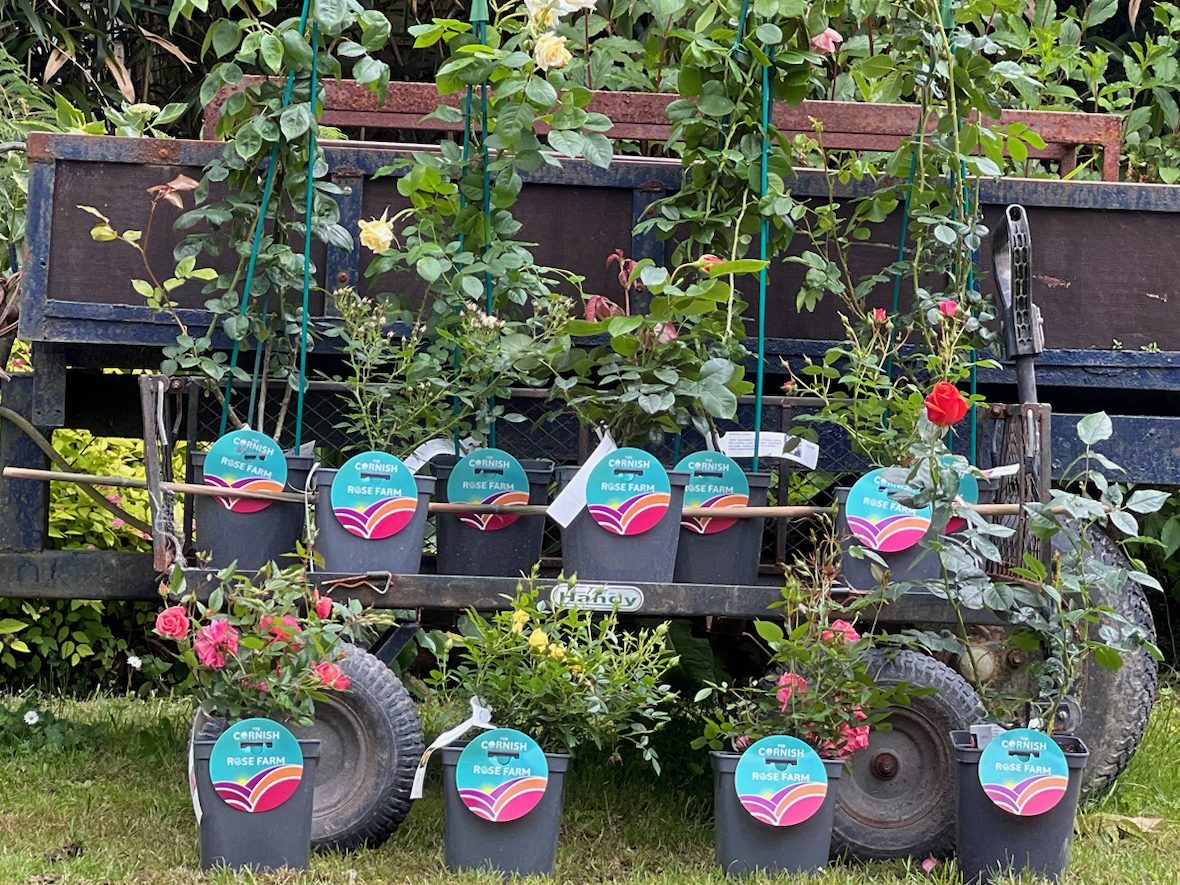
Roses are grown as crops in the field and become ready for sale in November. The roses we sell are grown by The Cornish Rose Company, in fields near Mitchell.
During the winter, roses are mostly sold in the traditional ‘bare rooted‘ or ‘field grown’ way. This is a good way of buying and planting roses when they are dormant, allowing them to grow strongly in the spring, after settling in over winter. Bare root roses are dug straight out the field and have no soil round their roots or pots, so they are cheaper to buy. The plants will always be packed in a way that keeps their roots moist, which is very important. They should be planted within a week of receiving them for best results.
We pot a large proportion of our crop too which then allows us to sell roses when they are actively growing – digging rose plants out the ground at any other time than during their winter dormancy will be certain death for them!

Types of roses
Generally, there are five main categories of roses which we stock at Lanjeth. They are Bush Roses (*which can be sub-divided into Floribunda and Hybrid Tea), Patio & Miniature Roses, Ground Cover Roses, Shrub or Historic Roses, and finally, Climbers & Ramblers.
- Bush roses are all your normal types of roses that would be used for planting in beds and borders and mixing in with herbaceous plants and shrubs.
- Patio and Miniature roses with neat, bushy growth and smaller flowers are ideal for growing in containers or at the front of the border. Height varies from 12cm to 30cm.
- Ground Cover Roses are, generally, wider than they are tall and characterised by having smaller blooms which repeat freely. Height can vary between 30cm to 80cm.
- Shrub/Historic Roses encompass all the old and historic garden roses which grow into large shrubs and add some stunning colour and form to the mixed shrub border. Many were bred more than 100 years ago by royal gardeners and passionate rose growers.
- Climbing Roses usually have large blooms, the ability to repeat flower and are of stout growth. Nearly all require support and training. Rambling Roses are more pliable in growth than climbers, have a lax habit and generally only flower once.
Floribunda is Latin for “many-flowering” and usually blooms are produced in sprays.
Hybrid Teas bear their flowers singly at the end of long stems, making them a popular choice for cutting.
Choosing a site
Roses are easy to grow. We always say ‘treat them as you would human beings and you won’t go far wrong’, i.e. lots to eat and drink, a bit of love and appreciation and you’ve cracked it!
Any soil will grow roses, but ideally try and choose a site that gets at least 50% of the day in the sun.
If you are replacing old roses with new roses remove as much of the old soil as possible and replace with soil that hasn’t grown roses before (the old soil will grow anything else apart from roses).

Treat them as you would human beings and you won’t go far wrong
Planting
Here are some steps to planting roses in the garden:
- In the area where the rose or roses are to be planted, mix in at least one bucket of well-rotted organic matter per square metre, forking it into the top 20-30cm (8in-1ft) of soil. Farmyard manure is ideal for this.
- Apply general fertiliser, at 100g per sq m over the surface of the planting area and fork it in to the same depth as the organic matter. Note:if you are using a mycorrhizal fungi (e.g. Rootgrow) then it is best not to apply a fertiliser at all as phosphorus (found in general fertilisers and superphosphate) can suppress the fungus.
- For each rose dig a hole roughly twice the width of the plant’s roots and the depth of the container it came in.
- Carefully tease out the roots of container plants because, if this is not done, the roots may be very slow to extend outwards, leaving the young plant more susceptible to drought in summer.
- Place the rose in the centre of the hole and, using a small cane to identify the top of the planting hole, ensure the graft union (i.e. where the cultivar joins the rootstock and the point from which the branches originate) is at soil level.
- Back-fill gently with the excavated soil and organic matter mixture.
- Water well.
If you are replacing old roses with new roses, ensure that you dig out the soil to a depth and width of 45cm (18in) and exchange it with soil from a different part of the garden, as roses are at risk from replant disease, also known as soil sickness.

Treat them as you would human beings and you won’t go far wrong
Feeding & Mulching
To get the best from roses they need regular feeding.
A clay soil will need the addition of a rose fertiliser twice a year, in March (after pruning) and after the first flush of flowers is over (usually late-June/July).
A sandy or chalky soil will need feeding monthly from March to end-July – a small handful of rose fertiliser will suffice.
Remember to also feed your roses twice a year in spring and mid-summer with a granular rose feed such as Empathy After Plant Rose Food ( roses in containers 3 times a year) which should also contain trace elements including Iron, Manganese and Boron. We also recommend ‘Toprose’.
Loamy soil will need a feeding regime in between the other two types.
Mulching is a good practise; garden compost, leaf mould or manure will keep the moisture in the ground, but bark chippings are best avoided. Keep the mulch clear of the rose stems by about 4”

An old rosey saying is ‘a well-fed rose is a healthy rose’.
Watering
If the ground is dry, water well occasionally.
Little and often watering is best avoided. Rose growers find watering in the morning or keeping the leaves dry reduces incidence of disease.
Roses will tolerate a dry soil but will perform best in a moist soil.
Pruning
When you first receive our roses they will arrive already hand pruned when appropriate, so all you will need to do at the start is plant and watch them grow and come into flower, New growth on Climbing and Rambling Roses will need supporting, training and tying in to trellis or wires (see below)
Pruning is easy, the rule of thumb being for established bush roses prune to 1/3 original size in a frost-free period from late winter to early spring.
Prune out any dead, damaged or weak, growth. Roses can be trimmed back after they finish flowering in November to stop wind-rock but the main pruning is done late-winter/early-spring. (If you are worried about pruning, don’t be, it’s quite acceptable to prune with a hedge trimmer!)

Summer Dead Heading
After the rose flower has finished blooming and the petals start to fall away, the remaining flower head, if pollinated, will then start to form a round hip and seeds, the forming of hips on the modern roses we supply is something you don’t want to encourage as leaving them on the rose then sends a message back to the rose that its job is done for the year and there is no need for it to flower anymore that year and all the plant’s efforts will then be put into producing hips and seed.
Cut these dead flowers off as soon as possible after flowering and the rose will then re-invigorate itself and re-shoot and re-flower, repeat this through summer and autumn and you will get up to 3 or 4 heavy flushes of flower from June until hard frosts on many of the varieties we supply and depending on the length and temperature of the summer.
Deadheading is easy, simply hold the old finished flower and prune off 2 or 3 leaves or 6 to 9 inches down to just above a leaf, the more leaves you leave the quicker the rose will re-flower as it will have more immediate energy; for roses with large heavy single flower heads and trusses make sure the stem you leave is at least the thickness of a pencil at the point of cutting, this will make the new shoot strong enough to support the flower head of the next rose flower, helping to stop blooms from drooping. Put all your waste cuttings onto the bonfire or bin rather than discarding on the ground around your roses, this will help to keep them disease free.
Winter Pruning
For all other roses we recommend pruning when conditions seem favourable (ie: when the snowdrops are flowering and the birds begin singing). In March for all areas, re-check the roses you have pruned for any further winter stem die-back, and if any is seen simply cut this off below the brown stem to healthy wood just above a leaf.
When you are hard winter pruning your roses these are points to consider and remember:
- Pruning any rose hard, is usually very beneficial and very unlikely to kill it.
- Pruning a rose back hard encourages completely new shoots from the base of the plant which will become main flowering branches in subsequent years.
- If, at the point of cutting, the core of the wood in the centre of the stem is white, the rose is alive at this point, if the core is brown at the point of cutting the stem is dead and you need to cut the stem back further until you get to a white core, sometimes this can take you back down to the very base of the plant.
- Where possible cutting back to thicker stems, minimum pencil thickness will promote new shoots strong enough to support the flowers and trusses in later months
- Although not essential, cutting the stems at a slight angle will help stop water sitting on the cut stems and help to prevent die-back problems.
- Cutting dead, thin, weak and old stems out of the middle of the bush or standard head, creating an open airy structure will help prevent disease problems through the season.
- Dispose of your rose pruning and cuttings in the bin or on a bonfire, don’t leave them laying around under your pruned roses long term or put them on the compost heap as this will also encourage disease problems in the future.
Pruning Guide by rose type
Repeat Flowering Climbing Roses
These will need support using wires or trellis, Initially, try to train the branches horizontally to create a framework which helps keep leaves and blooms lower down in later years, tie in new growth with soft string. After 2-3 years the rose should reach the desired height and once reached after flowering, prune off to your desired height. In following years flowering side shoots will emerge from the main branches you’ve left and these should be pruned back to 2″ from the main stems every year during the winter. In later years, cut back at least one of the main stems to about 6 – 12″ from the ground, this will encourage brand new basal shoots which you should then re-train as main flowering branches.
Patio Climbing Roses/Repeat Flowering Ramblers
These can be grown on an obelisk, on short pillars, arches and narrow trellis. Simply tie in growth as it goes up, no hard pruning required other than pruning to desired shape, summer dead-heading of large numbers of tiny dead flowers and hips can be done more easily by lightly trimming the whole plant using hedge shears.
Traditional Rambling Roses
Just plant and let go, some initial support and tying in may be needed, Rambling roses can be left for many years without pruning but if the rose does get too big, cut back after flowering in summer as many ramblers flower on the previous years new growth, otherwise leave the hips for a colourful autumn display.
English and Shrub Roses
Cut back all growth to around 60cm or 2ft in the winter.
Hybrid Tea & Floribunda Roses
Cut back all growth to around 30cm or 1ft in the winter.
Patio Roses
Just plant and let go, some initial support and tying in may be needed, Rambling roses can be left for many years without pruning but if the rose does get too big, cut back after flowering in summer as many ramblers flower on the previous years new growth, otherwise leave the hips for a colourful autumn display.
Pests & Diseases
Blackspot is probably the most off-putting aspect of rose growing, however there are a few simple steps that will prevent it.
Choose blackspot resistant varieties, there are lots of them and we are happy to recommend them – but please note they are resistant not immune. If your neighbour has blackspot-infected roses, so will you, only at a later date!
Keep your roses well fed with a proper rose fertilizer at least twice a season, but if you’re on poor sandy or chalky soil feed monthly, from March to August.
Try to avoid watering in the evening, water in the morning, trying to keep the leaves dry or, better, invest in a watering system that uses a seep hose. Evening watering encourages the growth of fungal infections as the leaves will remain damp overnight.
 Lanjeth Nursery & Water Gardens